Continuing with my articles focusing on things newbies might not know about at Gen Con, I’m going to take a turn and talk about playtesting. Gen Con is known for being the place where new games can be released. The Disney Lorcana games made a big splash not too long ago as a prime example. This year, playable versions of Dungeeon Crawler Carl: Unstoppable are expected to be played at Gen Con. Also making a splash this year is the Naruto card game (there were sessions still open for this at 8:00 and 9:00am at the time of this writing). There are dozens of new releases that will be found in the vendor hall and within the events.
But there are also a lot of game that will be mentioned that are not ready for grand releases, but rather are in still in development. In fact, there are many such games that are nearing completion, but are still open to being tweaked. Gen Con provides chances to get a sneak peek at some of these games. Even more interesting (and potentially fun) is the chance to play some of these games still being designed. Specifically, this is playtesting, which is a part of the process for any new games being built.
Playtesting happens both formally and informally at Gen Con. Both are open for attendees to participate. The informal playtesting occurs as a result of a large number of game designers (mostly hobbyists) wandering the convention hoping someone will agree to play their prototyped game. Many of these people find areas in the open game rooms and put up signs asking for players. The J.W. Marriott’s open game room is a place where this can happen.
From a more formal perspective, Gen Con has created the First Exposure Playtest Hall.
First Exposure Playtest Hall
The First Exposure Playtest Hall (FEPH) is an official part of Gen Con where designers and publishers present new prototypes. This is a paid service by Gen Con which results in a designated area for playtest sessions to happen. Gen Con then sets up free events to help drive people to the playtesting area. This means that Gen Con attendees that want to do the playtesting can get free tickets — attendees have the opportunity to play the prototyped games at no extra cost.
The Gen Con FEPH sessions run every two hours starting at 8:00 am and going to 10:00pm on Thursday, Friday, and Saturday as well as from 8:00 am to 2:00 pm on Sunday. If you search in the event finder for “First Exposure” you will see the list of time slots that you can select from. The descriptions will be similar to the following, which is relatively vague:
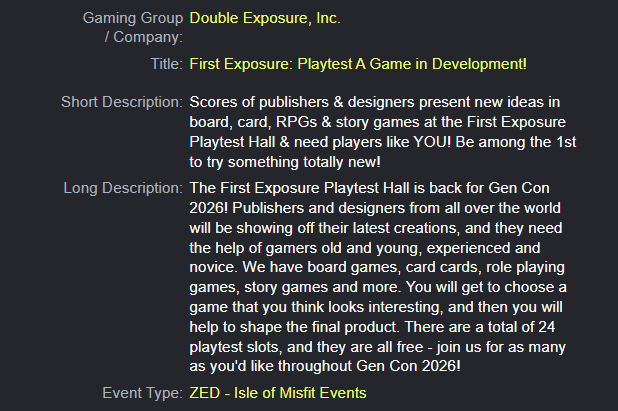
The description does not tell you the specific game you will be playing. When you arrive, however, they will try to match you with a type of game you like to play. The specific games will be dependent upon which designers are playtesting during the given slot.
As mentioned, these are ticketed events that take place in the ICC 107-110 rooms. Each event slot has over 100 tickets with most having around 120 or 160 tickets. At the time of this writing, only one FEPH event had one ticket available. All other events were sold out. Having said that, because the tickets are free, it is possible to stop by the FEPH near the start of each time slot to see if any additional openings are available due to no shows or due to there simply being space based on the games being playtested during the time slot.
Gen Con newbie tip: Playtesting generally happens on the even hour. Even without a ticket, if you stop by the table outside of the playtest area in rooms ICC 107-110, they can tell you if there is a chance for walk-ups to be included. They often do add a few people without tickets to fill out the games.
There are generally numerous games being tested during each time slot. The players are getting a chance to see a game that is not yet publicly available. Because this is playtesting, games are in a playable condition but might not be “production quality”. They are prototypes.
Getting Your Game Play Tested in the FEPH
It is beyond the scope of this post to cover how to get your test play tested in the FEPH. In short, if you have designed a game, you can apply prior to the tart of Gen Con to be included in the FEPH. There is a fee that has to be paid based on the type of test package desired. You can find more at https://www.gencon.com/gen-con-indy/first-exposure-playtest-hall-feph.
Playtesting Gaming Events
There are also other sessions listed within the Gen Con event catalog that also involve playtesting. For example, The Game Crafter does a Community Playtest Night where those attending the session take turns playtesting each other’s games (note this session has 24 tickets and is sold out). There are other sessions that focus on testing a specific game.
Clarity on “Game Designer”
To be clear, when I say “designer” I am referring to anyone that has created a game that they want others to play. Game designers at Gen Con can range from a person that has created one game idea on a couple pieces of paper all the way to professional designers who create games for a living. Many are simply game enthusiasts that had an idea that they materialized into a prototype.
As a shameful plug, I’m a game enthusiast that has prototyped a couple of games, In fact, I have two fully functioning games I’ve prototyped and carry around at Gen Con hoping to entice a publisher to consider them. I’m also happy to spend time in the open gaming areas to play my games and have other playtest them causally.
Prototypes by Any Other Name….
It is worth noting that the prototypes come in many different forms. The prototypes you play in the FEPH often look like regular games. In other areas of Gen Con where you might come across a game prototype being play tested, the game might be a much rougher. It is not uncommon to see prototypes that are made of standard index cards, zip lock bags, and pieces from other games. With prototypes and playtesting, it is about seeing if the game functions more than whether it looks pretty.
Shameless Plug: Speed Word Scramble and Gem Miners
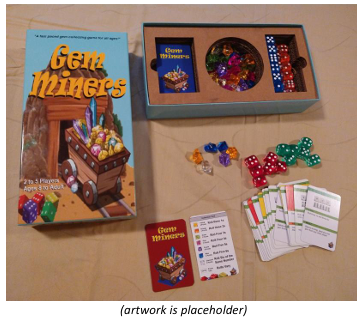
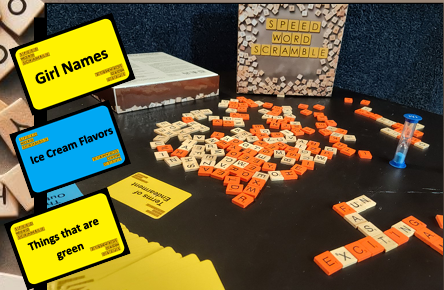
I have prototyped a few games with a several in various stages of development. I have also prototyped extensively play tested two games that are at the level that I’m pitching to publishers. The initial prototyped versions of the games were stored in boxes from other games. They were made with parts I created on my 3D printer, printed on my standard computer printer or pulled from other games. I also used resources such as laser printers from my local public library. There are vendors at Gen Con that sell various game parts including meeples, tokens, and (of course) dice, which are perfect for using in designing/creating a game. The one thing I’ve been told is that if you are creating a game to sell to a publisher, then it is more important to focus on the mechanics of the game than on the perfect presentation of the components. No matter how nice a game looks or how much a person might spend on original art, if it doesn’t play well, then publishers won’t want it. Better to focus on the mechanics first, then the article can be refined.
Gen Con newbie tip: Many people have games they’ve prototyped that they want to pitch (present) to publishes at Gen Con. It is possible to pitch a game to publishers at Gen Con, but it isn’t the primary focus of Gen Con, nor is it why publishers are there. Most publishers taking pitches have scheduled them prior to the startt of Gen Con, thus have little-to-no time to take unsolicited pitches. For those that do have time, note that there are likely hundreds of other people walking around Gen Con like me with prototypes in their bags hoping to get 5 minutes of a publisher’s time.
Gen Con new tip: If you are going to ask publishers doing a pitch for your game, note that they are likely to say no as many have already filled their schedules with planned pitches prior to the start of Gen Con. Before approaching a publisher, you should make sure your game truly fits within their catalog. Additionally, be aware that many people at the booths are generally sales personnel or temporary help — they are often not the people who take pitches.
Tip for Publishers: Of course, if you are a publisher and are interested in a fast-paced, creative, family party game where players race against the clock and their opponents to form the most clever words within a given category using a shared pool of letter tiles, then I’d be happy to pitch Speed Word Scramble to you. If you are more into dice games, then Gem Miners is a game that where players are rolling dice in the hopes of matching combinations to be able to grab gems or cards in a strategic manner to score the most points. Both can be pitched and a round played in under 10 minutes. Be aware that a lot of play testers ask to play another round! Let me know if you have 10 minutes at Gen Con and I can show you either game! They are fun family ‘board’ games that play testers have enjoyed playing. You can reach me at ShowMeTheGame@Jones123.com
In Conclusion
This article was the seventh in a series. I too a little liberty in this one to go a little off topic by mentioning my own prototyped games. Regardless, if you are looking for something different to do, then stop by the FEPH to see if there are any open slots. You can also look for designers hoping for play testers in the open gaming areas such as the one at the J.W. Marriott. You never know, you might have a chance to make an impact on a future blockbuster game!
# # #